
The Question That Would Not Leave
Do not be conformed to this world, but be transformed by the renewal of your mind, that by testing you may discern what is the will of God, what is good and acceptable and perfect.
>
- Romans 12:2, ESV
"God is not a mumbling trickster."
>
- Dallas Willard, `Hearing God`
A Question That Feels Responsible
Maya's final question is not unusual.
God, was that You?
For many believers, the question does not arrive as doubt. It arrives as devotion. It comes from the person who wants to be careful, who does not want to ignore God, who has been taught that obedience may depend on recognizing His direction in the moment.
So the question feels responsible.
Was that You?
Was that thought from You?
Was that feeling Your warning?
Was that opportunity Your open door?
Was that hesitation Your restraint?
Was that peace Your permission?
The question may sound small at first, but it carries a whole world inside it. It assumes something about God, something about the mind, something about spiritual maturity, and something about what faithfulness requires.
That is why it can become so exhausting.
Not because the believer asking it is unserious. Usually the opposite is true. The people most burdened by this question are often the ones most eager to obey. They are not looking for ways around God. They are trying, sometimes with great tenderness of conscience, to remain available to Him.
But sincerity does not keep a framework from becoming heavy.
When Testing Becomes Surveillance
The question "Did God tell me that?" can begin as a desire to honor God and slowly become a system of inner surveillance. A thought appears, and immediately the believer steps outside the thought to examine it.
This does not mean the question is always wrong. There are moments when it is wise to pause, pray, test what we are thinking, and ask whether we are being moved by love, fear, pride, wisdom, impatience, or the Spirit's work in us. Scripture does not commend thoughtless living.
But there is a difference between testing our thoughts and living as though every thought must be traced to its source before we are free to move.
Was that mine?
Was that God's?
Was it temptation?
Was it wisdom?
Was it fear?
Was it the Spirit?
The mind becomes both the place where the thought occurs and the courtroom in which the thought is tried.
That is a difficult way to live.
It becomes even more difficult when the thought in question is not obviously wrong. If a thought is clearly sinful, Scripture gives us clarity. If it is cruel, dishonest, proud, lustful, vengeful, or contrary to the revealed will of God, we do not need a special discernment process to identify it as something to reject.
But most of the thoughts that trouble us are not like that.
They are ordinary thoughts.
Call this person.
Apply for that job.
Wait before answering.
Say yes.
Say no.
Bring this up.
Let it go.
Nothing about those thoughts is automatically sinful. Nothing about them is automatically holy either. They live in the gray and ordinary space where much of human life actually happens.
And that is where the question begins to press.
If this thought is only mine, can I trust it?
If it is God's, am I required to obey it?
If I cannot tell the difference, what does that say about me?
This is where a subtle assumption often takes root: God's guidance is something that enters the believer's mind, becomes mixed with the believer's own thoughts, and must then be identified correctly. The spiritual task is to sort the inner material. God's thoughts over here. My thoughts over there. Fear over here. Wisdom over there. The Spirit over here. Personal preference over there.
The assumption may not be stated that plainly. It usually is not. But many believers live as if it were true.
And once it is true, faith becomes an uncertainty management system.
The goal is no longer simply to walk with God in trust, shaped by His Word and dependent on His grace. The goal becomes reducing the risk of misinterpretation. You pray, wait, listen, examine, compare, second-guess, and hope that eventually you will be able to say with enough confidence, "This was God."
The Cycle Tightens
For a while, that confidence can feel relieving.
You decide the thought was from God.
You move forward.
The decision now feels covered by something larger than your own judgment.
You may even feel joy. Not only because of the decision itself, but because you believe you recognized God accurately. For a moment, the system seems to work.
Then the path becomes difficult.
The job you believed God led you to begins to strain you.
The relationship you entered with confidence becomes complicated.
The ministry you said yes to starts exposing limits you did not expect.
The conversation you felt prompted to have does not go well.
And when difficulty comes, the old question returns with sharper teeth.
What if I got it wrong?
What if that was not God?
What if I confused desire with guidance?
What if I moved ahead of Him?
What began as trust can quickly turn into accusation. Not always accusation against God. Often accusation against yourself.
I do not hear well.
I cannot trust my thoughts.
I am too emotional.
I am not spiritual enough.
I thought I was following God, but maybe I was following myself.
Then, the next time a decision comes, the believer returns to the same place, only with less confidence than before.
Is this me, or is this God?
That is the cycle.
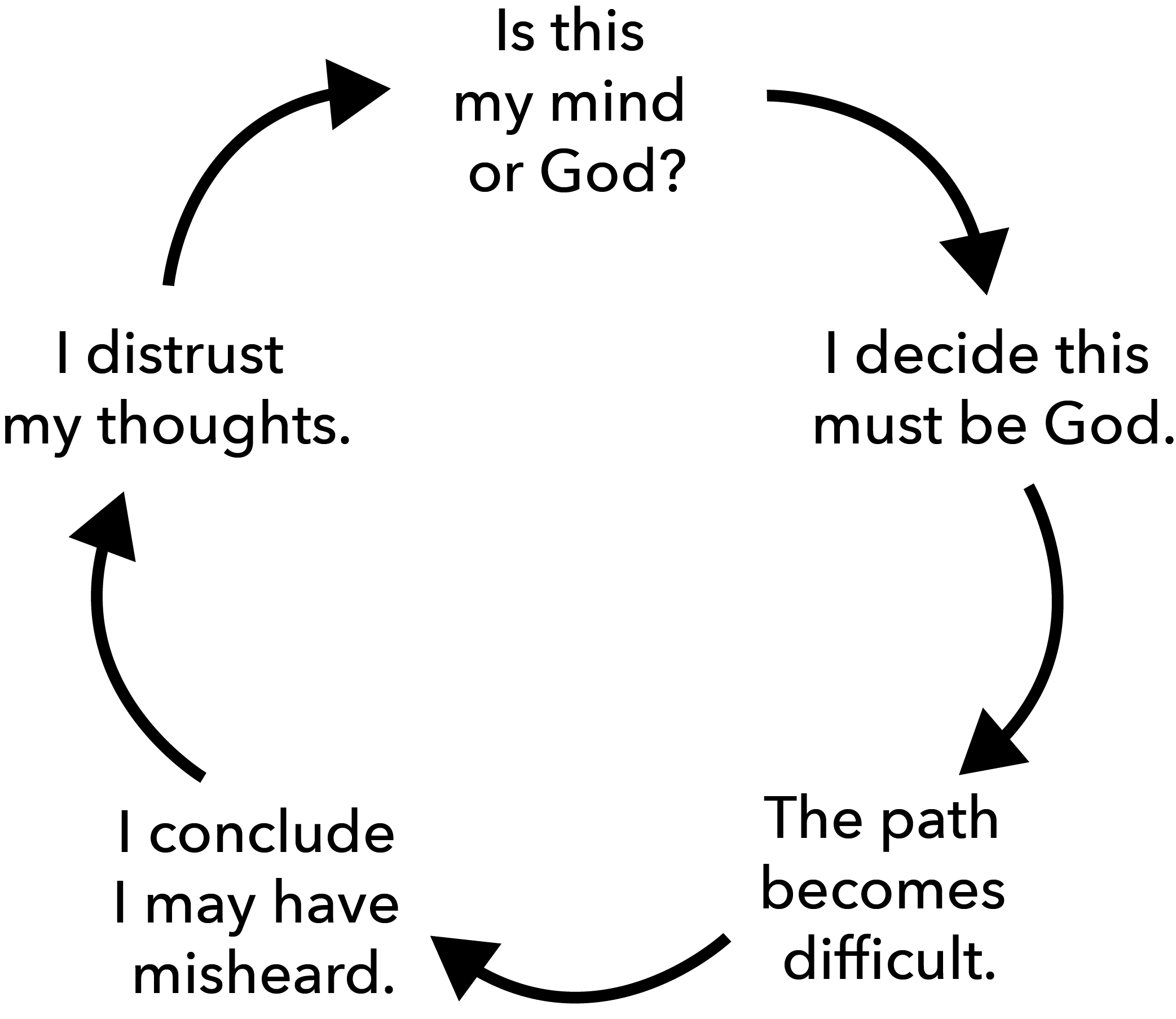
It can repeat for years.
And because each turn of the cycle seems to confirm the need for caution, the believer may not recognize the deeper problem. The issue appears to be a lack of clarity. If only God would speak more plainly. If only the inward signal were stronger. If only the believer could become more sensitive.
But what if the problem is not merely that the signal is unclear?
What if the problem is the way we have learned to imagine guidance?
That is a more unsettling question at first, but it may also be the beginning of relief.
Because the "me or God" question often smuggles in a view of spiritual maturity that Scripture itself does not require. It assumes that the mature believer is the one who can detect God's private direction inside the flow of ordinary thought with increasing accuracy. Maturity becomes sensitivity to inner distinction. Faithfulness becomes correct identification.
The Mind God Forms
But Scripture repeatedly describes maturity in another way.
It speaks of the renewing of the mind. It speaks of discernment being trained. It speaks of wisdom, understanding, love, knowledge, counsel, and the Word of God shaping the person who belongs to God.
Romans 12 does not call us to escape our minds, but to have them renewed so that we may discern the will of God. Hebrews 5 does not describe maturity as the ability to separate divine impressions from human thoughts, but as discernment trained by practice. Those are not small differences. They suggest that God is not merely dropping guidance into us for detection. He is forming the kind of person who can recognize and walk in what is good.
That is not the same as saying God is absent from our thoughts.
It is not the same as saying the Spirit does not lead.
It is not the same as saying a believer should become self-reliant, prayerless, or closed to God's personal involvement.
God can guide personally. He can convict, comfort, redirect, bring Scripture to mind, expose what we were avoiding, and draw attention to what wisdom requires. The question is not whether He is able to do any of that. The question is whether He has promised to lead His people by giving them a constant internal signal they must identify before acting faithfully.
It is saying that Scripture does not require us to treat every thought as a possible coded message whose origin must be discovered before we can act faithfully.
That distinction matters.
If the Spirit's work is primarily imagined as the insertion of divine thoughts into the mind, then the believer's ordinary mental life becomes suspicious. But if the Spirit's work includes forming judgment, renewing perception, shaping desires, and training discernment through the Word of God, then the mind is not merely a risky place where divine and human thoughts get mixed.
It is a place God is able to form.
That may sound less dramatic than hearing a distinct instruction.
But it is not less spiritual.
In fact, it may be closer to the kind of maturity Scripture consistently places before us: a life so deeply shaped by God that obedience is not always experienced as an interruption from the outside, but as a growing capacity to recognize, love, and walk in what is good.
This does not remove all uncertainty.
It does not make every decision easy.
It does not mean every thought should be trusted simply because it occurs to us.
But it does begin to loosen the fear that anything sounding like "me" must be spiritually suspect.
That fear has done more damage than many of us realize.
It has made people afraid of their own judgment.
It has made wisdom feel less spiritual than impressions.
It has made prayer feel like a search for hidden instructions.
It has made difficulty feel like evidence that we misheard God.
And perhaps most painfully, it has made some sincere believers experience God as someone who is willing to guide them, but only in ways they may not be able to recognize until it is too late.
We need to slow down there.
The God This Question Assumes
Because if a model of guidance consistently produces fear, self-distrust, and a picture of God as cryptic or difficult to follow, then we should be willing to ask whether that model deserves the authority we have given it.
Not every spiritual instinct should be adopted simply because it feels reverent.
Some instincts sound humble while quietly disagreeing with the character of God.
So before we ask how to get better at answering, "Was that God?" we need to ask a prior question:
What kind of God does this question assume?
We should be careful here.
Most people do not consciously imagine God as cryptic. They do not sit down and decide to believe in a God who hides His will in the middle of their own thoughts and then holds them responsible for decoding Him correctly. If you stated it that plainly, many believers would reject it immediately.
And yet, practically, that is often how the system feels.
God is near enough to give direction, but not always clear enough to be recognized.
He is willing to lead, but His leading may arrive in a form that is almost indistinguishable from anxiety, desire, memory, preference, fear, wisdom, or fatigue.
He has a will for the moment, but the believer may miss it by failing to notice the right internal signal.
That picture does not usually arrive as doctrine. It arrives as experience. It forms through repeated attempts to be faithful under uncertainty. It grows stronger each time a person says, "I thought God was telling me this," and then later feels embarrassed, confused, or spiritually exposed when the outcome becomes painful.
The difficulty is not only that this way of thinking makes decisions harder.
It begins to reshape God.
Not officially.
Not in the creed.
But in the imagination.
God becomes someone whose guidance is both necessary and difficult to verify. Someone whose will may be close, but hidden. Someone whose children must search their own inner life for traces of His direction and then live with the consequences of whether they interpreted those traces well.
Again, this can feel reverent.
That is part of why it survives.
It feels reverent to say, "I do not trust myself." It feels humble to say, "I do not want to move unless God tells me." It feels careful to say, "I need to know whether this is God or just me."
But not everything that feels humble is actually humility.
Sometimes humility says, "My thoughts need to be formed by God."
Anxiety says, "My thoughts are dangerous unless they can be separated from me and certified as divine."
Those are not the same thing.
One opens the mind to renewal.
The other teaches the mind to fear itself.
When A Thought Gathers Meaning
Consider how this plays out in an ordinary thought.
A believer is washing dishes when a name comes to mind.
Send a message to Natalie.
At first, the thought is simply a thought.
Then it begins to gather meaning.
That morning, she had prayed that God would make her available. The sermon the previous week included a line about encouragement. A friend had recently told a story about feeling prompted to reach out to someone at exactly the right time. None of those things directly answer the question, but together they begin to feel like a pattern.
Maybe this is God.
So she sends the message.
The reply is brief.
Polite, but not warm.
Now the thought has two layers.
There is the ordinary layer: perhaps Natalie was busy, tired, distracted, or unsure what to say.
And there is the spiritual layer: what did that original thought mean?
Did God bring Natalie to mind?
Did she turn a random thought into guidance?
Did she intrude where she was not supposed to?
Did she miss the point?
The problem is no longer simply, "That exchange felt awkward." It becomes, "What does this awkwardness reveal about my ability to recognize God?"
That second question can do more damage than the awkward exchange.
Because if the conclusion is, "I misheard God," then the next thought begins under suspicion. Her own mind becomes less trustworthy. Her ordinary desires to encourage, speak, wait, ask, or move become suspect. Even prayer feels less stable, because she remembers how easily a thought gathered spiritual meaning before.
So she becomes more cautious.
And because she becomes more cautious, the next thought requires more internal evidence. More prayer. More waiting. More signs. More confirmation. More fear of getting it wrong.
The system tightens.
We will return later to what outcomes can and cannot prove. For now, notice the loop. Source-tracing promises safety, but it often leaves the believer less able to trust the mind God intends to renew.
This is why the deeper issue is not merely how to interpret thoughts. It is how we understand God's way of forming people.
Romans 12 is helpful here because it does not invite us into passivity. Paul does not say, "Stop thinking so God can direct you." He calls for transformation by the renewing of the mind so that the people of God may discern what is good, acceptable, and mature before Him.
That is a different picture.
The mind is not bypassed.
It is renewed.
Discernment is not treated as a mysterious ability to identify which thoughts came directly from God. It is connected to transformation. It is the fruit of a life being reshaped.
Hebrews 5 gives a similar picture from another angle. The mature are described as those whose powers of discernment have been trained by practice. That language matters. Training takes time. Practice involves repeated use. Discernment grows as a person learns, fails, adjusts, receives instruction, and becomes more able to recognize the difference between good and evil.
This is not the language of instant certainty.
It is the language of formation.
And formation is slower than a signal.
That may be why we sometimes resist it.
A signal feels safer. A sign feels cleaner. A distinct impression seems to remove some of the burden from us. If God tells me what to do, then I do not have to carry the same responsibility for choosing.
But Scripture does not present maturity as the disappearance of responsibility. It presents maturity as the transformation of the person who bears responsibility before God.
This is where a great deal begins to shift.
If guidance is mainly imagined as God inserting instructions into the mind, then the believer must become skilled at detecting those instructions.
But if guidance includes God renewing the mind, training discernment, shaping desires, giving wisdom, correcting motives, and forming love, then the believer is not trying to escape ordinary thinking.
The believer is learning to think faithfully.
That does not mean every thought is wise.
It does not mean desire is automatically trustworthy.
It does not mean anxiety should be ignored.
It does not mean every open door should be entered or every persistent thought followed.
But it does mean that a thought does not become spiritually inferior simply because it sounds like you.
That sentence may take time to believe.
For some people, it may feel almost unsafe. They have been trained to think that the safest spiritual posture is suspicion of self. But Scripture's answer to the self is not simple suspicion. It is death and renewal. It is repentance and formation. It is the old self being put off and the new self being put on. It is the Spirit bearing fruit in actual human lives, not replacing those lives with a stream of divine instructions.
God does not become less involved because your thought sounds like your voice.
He is not limited to guidance that feels foreign to you.
He is able to work in you so deeply that what is wise may eventually feel, quite naturally, like your own judgment.
That is not a threat to dependence.
It may be one of the fruits of formation.
A Better Set Of Questions
This gives us a different way to respond when the question rises again.
Is this me or God?
We do not need to panic. We do not need to answer too quickly. We also do not need to treat the question as though everything depends on solving it.
We can slow down and ask a better set of questions.
What picture of God am I assuming right now?
Am I testing this thought wisely, or am I trying to source-trace it anxiously?
Has God already made anything morally clear?
Is this thought consistent with the character and wisdom Scripture commends?
Do I need counsel?
Do I need more information?
Do I need courage to act, or patience to wait?
These questions do not form a new technique. They will not guarantee certainty. They are not a spiritual machine that produces the correct answer if used properly.
They simply move us out of panic and back toward formation.
They allow us to test a thought without placing our entire relationship with God on the outcome of that test.
They allow us to pray without demanding that prayer produce an immediately identifiable instruction.
They allow us to recognize that God may be leading us not by giving us something to decode, but by making us the kind of people who can increasingly discern what love, wisdom, obedience, and trust require.
That kind of life will still involve uncertainty.
But uncertainty will not have the same authority.
It will no longer be able to say, all by itself, "God must be withholding something."
It will no longer be able to say, "If you cannot identify the source of this thought, you cannot move."
It will no longer be able to say, "If this becomes difficult, you must have misheard Him."
This is not the whole answer to guidance. We still need to think about decisions, signs, silence, prayer, Scripture, wisdom, community, mistakes, and the stories in the Bible that so often shape our expectations. Those questions matter, and we will come to them.
But the first relief begins here:
You are not responsible to identify the origin of every thought before you can walk faithfully.
You are responsible to bring your whole self before God, to let your mind be renewed by His Word, to seek wisdom honestly, to test what needs testing, to confess what needs confessing, and to move with humility as He forms you.
That is already a different way to live.
And once that difference becomes visible, we can begin to see something else: the "me or God" question rarely stays confined to a single thought. Over time, it spreads. It begins to attach itself to more decisions, more opportunities, more ordinary moments.
What starts as a question about one thought can become a way of experiencing nearly everything.
That is where we need to go next.